


4 steps from DBT that can boost your self-esteem
- Natasha
- Feb 27, 2023
- 5 min read
Lets start off by explaining what DBT is, DBT is short for Dialectical Behavioral Therapy.
Now what exactly is DBT, it is a structured program of psychotherapy with a strong educational component. It is designed to provide skills for managing intense emotions and negotiating social relationships. It was Originally developed to curb the self-destructive impulses of chronic suicidal patients, it is also the treatment of choice for borderline personality disorder, emotion dysregulation, and a growing array of psychiatric conditions. DBT consists of group instruction and individual therapy sessions, both conducted weekly for six months to a year,
The “dialectic” in dialectical behavior therapy is an acknowledgment that real life is complex, and health is not a static thing but an ongoing process hammered out through a continuous dialogue with your self and others. It is continually aimed at balancing opposing forces and investigating the truth of powerful negative emotions. DBT acknowledges the need for change in the context of acceptance of situations and recognizes the constant flux of feelings, many of them contradictory, without having to get caught up in them. Therapist and teachers help patients understand and accept that the thought is an inherently messy process. DBT is itself an combination of science and practice.
Low self esteem seems to be almost an epidemic in our society, yet we play the part of feeling strong and acting confident by what we all know as "putting on the face". This is also referred to as 'Imposter Syndrome". With Imposter Syndrome you present yourself as the perfect employee, spouse, parent, friend, etc but inside you feel like a fraud, weak and falling apart at the seams. It takes tremendous energy to keep up appearances when you are in emotional pain, so the growing weariness burdens you even more and you end up in a repeating cycle: perform, pull yourself up/collapse, suck it up/perform. Building self esteem takes time and it occurs in little steps, little wins. Every time you follow one of the steps below your self esteem grows a little bit more, and every time you do the opposite your self esteem takes a step backward. Building self esteem is all about living in agreement with your values and treating yourself and others fairly. You might be asking yourself what that means?
We have opportunities to build self esteem each and every day. It takes awareness of our actions, followed by making conscious and intentional choices
You can use the acronym *FAST" (a dbt acronym that is known for keeping your own self-respect) to help you remember steps you can take when making daily choices to build self esteem and get past the "Imposter Syndrome".
F-Air A-pologies S-tick to Values T-ruthful
a. Fair
Be fair to not only yourself but to others as well. Respect your own boundaries and don’t put others' needs and desires ahead of your own unless they are your children of course. Show that you are assertive, but not aggressive. And show others that you have the right to speak your own truth, but can also be a compassionate listener to any topic or discussion.
b. Apologies
A stands for apologies. But it actually means no apologies. Don’t be overly apologetic. You don’t need to make unjustified apologies. For example, times you should not apologize are when you have to ask for something, are in someone’s way, or even just feel like a burden on others. Many people struggle with over- apologizing because of feelings of resentment, low self-esteem, or frustration. This is also showing the opposite of self-respect! People often apologize to avoid conflict, but you do not need to say sorry for speaking your own opinion or for standing up for yourself. Everyone has a right to their own opinion and the right to stand up for what you believe in.
c. Stick to Values
When you are in the situation of having to prove your values to someone, do not let down! You have a right to your own beliefs. And you should be able to follow your own path that you have created for yourself. Make time to do what is important to you and make time for your loved ones as well. If your loved ones feel abandoned by your values and what you dedicate your own time to, then that relationship may not be what is best for you at that moment. I always like to tell Family and Friends to embrace life, treasure the moments, take the pictures, and make those memories because you never know what can happen. Time is the biggest gift you can give someone.
d. Truthful
Being truthful is a big value in DBT. Don’t make excuses for yourself or anyone else, no little white lies or exaggerations, no leaving parts of a story out and don’t take advantage of others when they are offering you help. Lying often occurs when someone is trying to avoid a situation or conflict, but in order to be your best self, you must face the facts. Create a situation for yourself where you will never have to worry about what you told someone so that you can respect them and respect yourself at the same time. Trust goes a long way.
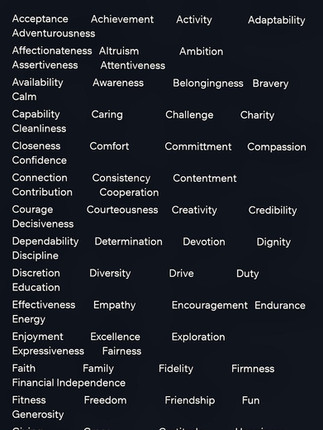
Here is a list of possible values you may hold close to your heart. Please add your own if you don't see it included, remember the possibilities are endless. Pick out your top 5 values and write them down somewhere you will see them and be reminded of them everyday. Your bathroom mirror or the fridge are good places. It is usually hard to select only 5. You might need to select more than 5 and then keep paring down the list by considering what you can live without.
Now, every time you make a choice consider your 5 top values and ask yourself:
a. Does this reflect my values?
b. Does this get me closer to my goal?
c. Will I feel better or worse after I do this?
d. What does my gut tell me to do?


Dialectical Behavior Therapy (DBT) skills such as the ones outlined here can help you build your overall happiness and daily satisfaction with life. We aren't born knowing these skills and there are no classes on them in school (yet) but it's never
too late to learn.

I hope you find some of these skills useful and can start tackling your low self-esteem. Noone deserves to feel low about themselves no matter what the case is. So lets all do our part and help, a simple good morning handsome or hello beautiful, can go a long way. I hope to hear how you have helped to uplift a complete stranger in the world. Stay tuned for more tips.
Growth4Life


Comments